Optimising Records Management with Raised Storage Areas
The commercial archiving sector faces a persistent challenge: rising industrial land costs alongside the need to scale. For a document storage facility, profitability is traditionally tethered to physical footprint. However, as urban density increases, simply acquiring more warehouse space is no longer a sustainable strategy for growth.
We recognise that your clients span a multitude of industries, from legal and financial sectors to healthcare and government. This diversity leads to a vast array of documents requiring specific document storage solutions. Managing this volume requires a departure from traditional pallet racking toward sophisticated, high-density infrastructure for records management that treats every cubic metre as a revenue-generating asset.
Protecting Asset Integrity and Compliance
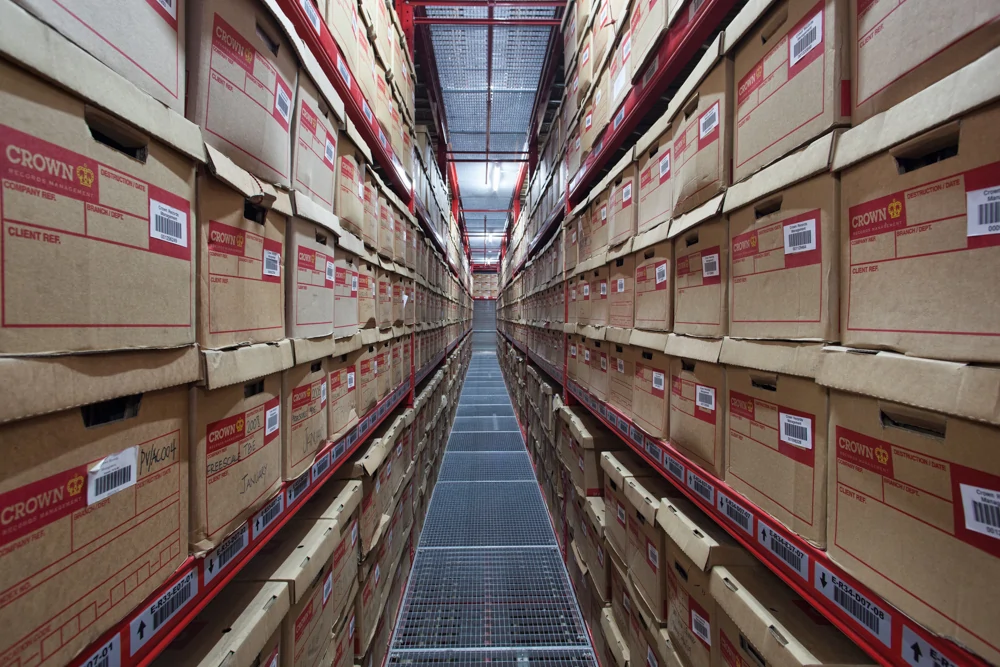
Operating records management storage facilities involves navigating a complex web of statutory requirements. Locally, the Australian Securities and Investments Commission (ASIC) and the Australian Taxation Office (ATO) set the benchmark for compliance. Most business records—including income, expense, and GST documentation—must be retained for at least five years, while company registers and financial reports often require a seven-year retention period under ASIC regulations.
Beyond financial data, records and information management must adhere to ISO 15489. This international standard ensures that records remain authentic and usable throughout their lifecycle. Failure to maintain these standards can lead to severe consequences, including significant fines, legal liability during discovery, and the loss of accreditation. Physical infrastructure must therefore provide “reasonable security safeguards” against unauthorised access or loss to ensure total business records management integrity.
Driving Profitability in Records Management Facilities
In the commercial archiving industry, the primary metric for success is volumetric efficiency. To increase revenue per square metre, a facility must maximise its billable carton positions. We view warehouse infrastructure not just as steel shelving, but as the most critical investment for a records storage company.
The right records storage management infrastructure mitigates significant legal and financial risks. By utilising the right storage solutions, you can streamline operational throughput—reducing the time staff spend retrieving and refilling boxes. This efficiency encourages long-term sustainability by lowering the energy and labour costs associated with a sprawling, unoptimised floor plan. When you can demonstrate a secure environment that ensures asset longevity, you establish a level of client trust that is essential for high-value contract retention.
Why Choose Dexion as Your Records Management Storage Solution Provider?
Dexion provides a customised, one-stop solution that handles the entire lifecycle of a project, from initial facility planning and design to final execution. Our approach ensures that your office document storage facility is built with compliance at its core.
Safety and security are non-negotiable. Our systems are designed to integrate seamlessly with fire protection sprinklers and warehouse climate control units, ensuring that sensitive paper documents are protected from fire, moisture, and pests. Our racking structures are engineered for high-density storage, offering resilience to seismic activity and heavy floor loads. By choosing our structural solutions, you are investing in a cost-effective framework that allows your business to scale vertically rather than horizontally.
Dexion’s Industrial Storage Solutions for Records Management in Australia
Raised Storage Area
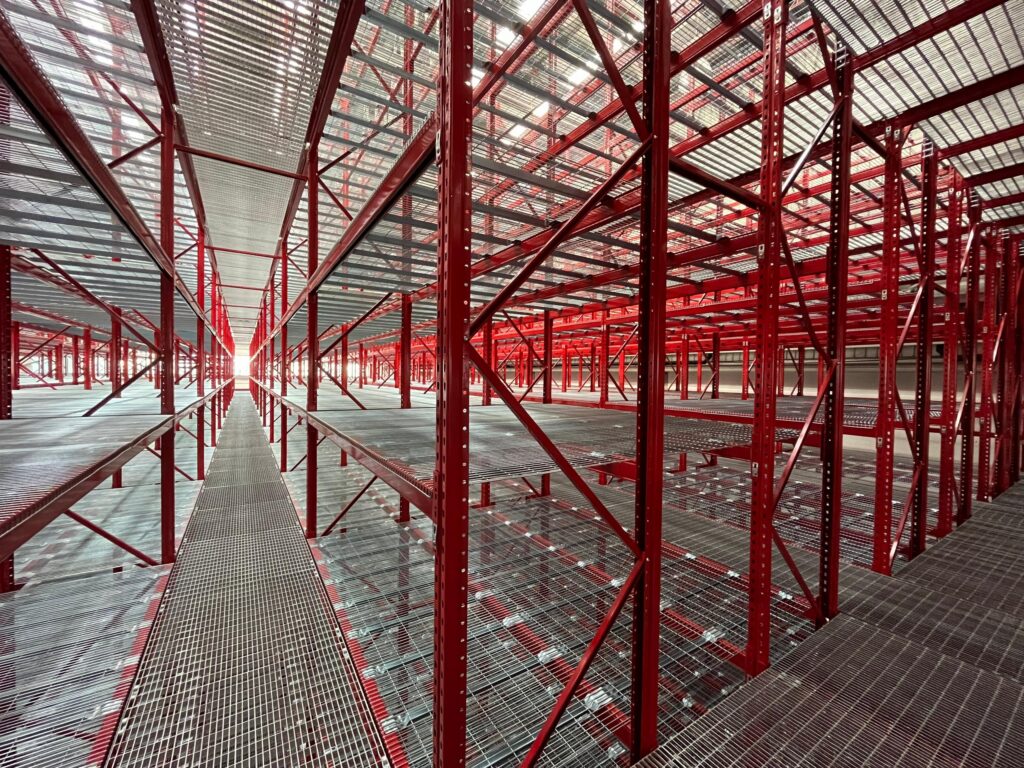
When floor space is at a premium, Dexion’s mezzanine structures allow for multi-tier storage. By looking upward, these raised storage areas effectively double your capacity within the same footprint, allowing for high-volume records storage management without the need for facility expansion.
Rack-Supported Raised Storage Areas
A rack-supported system utilises the existing storage framework to provide the structural base for a mezzanine floor. This is a highly efficient application for records management because it creates tiered platforms for multi-level picking access.
- Flooring and Finish: These platforms are typically fitted with mesh-grated steel for airflow and fire safety or high-durability ply flooring for heavy foot traffic.
- Operational Flow: These systems are engineered to enable more efficient material flow and can easily harness a conveyor system to move archive cartons between levels.
- Archival Optimisation: This configuration is perfect for records management because it is specifically designed for lightweight, hand-loaded items. It allows for a “two-speed” distribution system—where active records are kept on the ground floor while long-term archives are moved to the upper tiers.
- Flexibility: Unlike permanent concrete floors, rack-supported areas are easily dismantled and reconfigured, allowing the storage layout to evolve as the business scales or client requirements change.
Structural Raised Storage Areas
Structural raised storage areas are engineered using heavy-duty steel beams and columns to create a completely independent platform. This approach is designed to provide a high-load-bearing environment while maintaining the least possible obstructions on the ground level.
- Uninhibited Floor Space: By utilising structural steel, the number of support pillars is significantly reduced. This gives you uninhibited floor space both above and below the mezzanine, allowing for the movement of heavy machinery or large-scale sorting operations underneath.
- Bespoke Engineering: Each structure is tailored to fit the exact shape of the site and the specific load-bearing performance required for high-density paper storage, which can become incredibly heavy when fully consolidated.
- Multi-Tier Compatibility: These platforms are designed to accommodate multi-tier applications, providing the structural integrity needed to stack several levels of shelving or racking on top of the mezzanine floor.
- Seamless Integration: Standard archival shelving can be easily added above or below the floor, ensuring that the facility maintains a clean and organised layout that maximises every cubic centimetre of the warehouse.
Future-Proofing Your Archive
The longevity and security of stored documents are affected by everything from structural load capacities to environmental stability. As a provider of records management infrastructure, we focus on future-proofing your facility to lower overhead costs and ensure the long-term sustainability of your client data.
By optimising your cubic space today, you ensure that your business remains competitive and compliant in an increasingly tight real estate market. Contact Dexion today for a high-density configuration plan on how to maximise your site’s efficiency and revenue per square metre.
