

Frequently Asked Questions About MDS ASRS
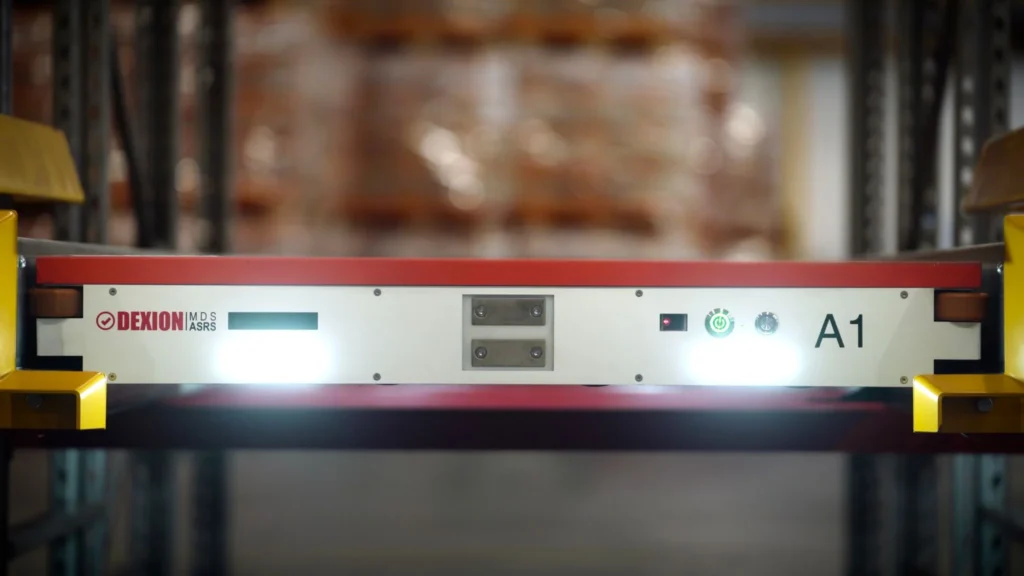
1. How does Dexion’s four-way shuttle position itself?
The MDS ASRS adopts the Dexion Datamatrix Barcode Positioning as the primary navigation method for shuttles within a compact racking system.
2. What is the role of barcode positioning in a four-way shuttle system?
Industrial cameras read engineered barcode labels mounted along travel paths so shuttles can move, stop, align, and transfer materials with accuracy.
3. What accuracy does barcode positioning provide?
Each data code encodes both the absolute system location and the relative position from the barcode center, providing millimetre-level precision for shuttle navigation.
4. Are there blind spots when it comes to reading the barcode?
Industrial cameras on the shuttles have a wide and forgiving range of 50mm – 500mm. Barcodes are read from a consistent height above the location, eliminating blind spots.
5. How are barcodes protected from physical damage?
Barcodes are mounted clear of shuttle travel paths, preventing physical contact and eliminating risks of abrasion or tearing.
6. How resistant are barcodes to dust and dirt?
• Normal warehouse dust levels do not affect the legibility of barcodes.
• Each Dexion Datamatrix location label contains 16 individual data codes. Even if dust obscures part of the label, the system only needs 1 out of 16 codes to home accurately.
7. How does Dexion Datamatrix Location Barcode compare to standard industrial barcodes?
• Enhanced material quality.
• Higher contrast for reliable scanning.
• Hard-wearing undercoat and overcoat for durability in warehouse environments.
8. Why is barcode favourable over RFID for four-way shuttle navigation?
Barcodes are a mature, proven, and cost-effective technology providing high level accuracy, scalability, simple integration, and predictable maintenance. Limitations of RFID include:
- Higher cost as it requires readers, antennas, controllers, and costly tags that cost 10-50 times more than barcodes.
- Added complexity, as passive and active tags both require additional power management and can generate radio frequency noise that interferes with Wi-Fi networks.
- Limited position accuracy as it detects only zones or presence but not exact vehicle position.
- Reliability only in controlled environments – disruptions occur with metals, liquids, or varied pallet materials.
- Humidity and temperature can cause reduction in signal and read failures.
- Regional differences in power emission rules (EU vs US vs Asia) complicate deployment and require unique engineering for each market.
