

In modern logistics, industrial facilities face constant pressure to improve floor space utilisation and throughput speed. To address these demands, we developed the MDS ASRS—an autonomous multi-directional shuttle system designed specifically for optimal space configuration and rapid material handling.
By replacing traditional wider access aisles with a highly dense, structured matrix, this system increases storage capacity by up to three times compared to conventional racking arrangements.
Engineered for structural efficiency, the lightweight system minimises mechanical wear and maximises operational longevity under demanding, multi-shift schedules.
Industrial operations require scalable equipment that can adjust alongside shifting inventory profiles and structural expansions. The MDS ASRS architecture is modular and easily configurable, allowing companies to scale their fleet or modify layout paths as business needs evolve over time.
Navigational Capabilities of the MDS ASRS
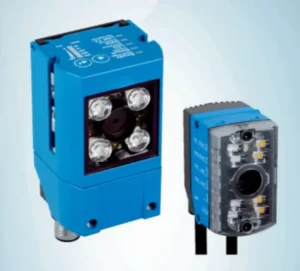
To operate safely and efficiently within highly compact configurations, autonomous shuttles require infallible pathfinding systems. The MDS ASRS technology adopts the Dexion Datamatrix Barcode Positioning architecture as its primary method for guiding individual units through the storage matrix. By relying on digital barcode checkpoints rather than mechanical tracks, the system eliminates guide errors and alignment drift.
The operational framework relies on heavy-duty hardware integrated into each moving unit:
- Industrial-Grade Cameras: Downward and lateral scanning matrices are mounted directly to the shuttle chassis, reading optical markers in real-time.
- Engineered Barcode Labels: High-definition barcodes are precisely affixed along physical travel paths, cross-ties, and track intersections.
By capturing continuous optical feedback at high frame rates, each ASRS shuttle system vehicle processes its exact coordinates relative to the physical grid. As a result, shuttles can move, stop, align, and transfer materials with absolute accuracy, eliminating collisions and reducing mechanical stress on the racking frame during high-speed travel transitions.
How Accurate is the Barcode Positioning in the MDS ASRS?
Each individual datamatrix code is unique and encodes two distinct data points simultaneously: the absolute system location within the overall warehouse grid, and the relative position coordinates measured directly from the barcode centre. This dual-layer data structure provides millimetre-level precision for shuttle navigation, ensuring consistent alignment during retrieval cycles.
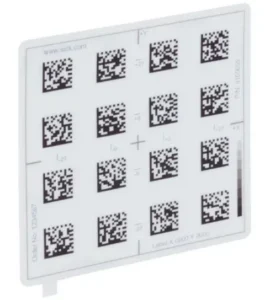
ASRS Technology with Barcode Positioning for Maximum Performance
Warehouse environments present distinct challenges for optical scanning, including airborne dust, ambient lighting variations, and structural vibrations. The Dexion Datamatrix Location Barcode features enhanced material quality, utilising a higher-contrast substrate combined with a hard-wearing undercoat and protective overcoat. This multi-layer construction ensures long-term readability even after millions of camera exposures.
Physical longevity is further assured by strategic component placement. The optical labels are mounted clear of shuttle travel paths, isolating them from direct wheel contact, structural deflection, or accidental pallet impacts. This design significantly lowers maintenance overheads and prevents unneeded operational downtime.
Evaluating Optical Navigation Against Alternative Technologies
When engineering a multi-directional matrix, choosing the correct positioning system is critical to operational stability. Optical datamatrix tracking proves highly favourable over Radio Frequency Identification (RFID) systems for a four-way shuttle architecture for several operational reasons:
- Cost and Complexity: RFID systems require widespread deployment of transponders and complex tuning across the grid, adding deployment expenses and system intricacy.
- Positional Tolerances: RFID signals lack the exact millimetre-level definition required for high-density positioning, whereas optical barcodes offer exact coordinate centring.
- Environmental Sensitivity: RFID performance depends heavily on controlled environments free from electromagnetic interference. Fluctuations in relative humidity and seasonal temperature swings can weaken RF signals, leading to reduced reading ranges and increased detection failures.
For a robust four-way shuttle system, optical infrastructure delivers predictable tracking consistency. Whether handling a specialised 4-way pallet shuttle mechanism, our barcode positioning platform maintains operational continuity without signal degradation.
Conclusion
Selecting reliable navigation infrastructure is key to maintaining high throughput and minimising the total cost of ownership. The MDS ASRS navigation technology is engineered to provide predictable, repeatable positioning accuracy, helping future-proof warehouses and distribution facilities against rising labour costs and changing market dynamics.
Contact Dexion to learn how the MDS ASRS can be integrated into your industrial storage system.
